Sewage rising out of a toilet, tub or floor drain is one of the most stressful water problems a household faces. Before cleanup can be planned, it helps to know where the blockage sits, because that decides who fixes the pipe and how fast the house can be cleaned.
Key takeaways
- Sewage backups are treated as Category 3 water, which means contaminated, and porous materials that touched it are usually removed.
- Water and sewer service here is provided by the Johnson County Special Utilities District, whose wastewater department serves primarily the City of Joshua.
- If several drains back up at once, the blockage is often farther down the system than a single fixture.
- No one should wade through, mop or vacuum sewage with household tools.
- Cleanup and the pipe repair are separate jobs, and either one can start before the other is finished.
Who runs sewer service here
The City of Joshua says water and sewer service is provided by the Johnson County Special Utilities District, also called JCSUD. JCSUD has a wastewater operations department that serves primarily the city.
JCSUD also lists an emergency option on its main phone menu for utility emergencies. That is the right place to report a problem that appears to be on the utility side.
The city is a Home Rule municipality along Highway 174, and the 2020 census counted 7,891 people. The city describes its population as just over 9,200 residents, a sign of steady growth.
Telling a home side problem from a utility side problem
The first question is where the blockage sits. A single slow drain points toward a clog in that fixture or its branch pipe.
Several fixtures failing together point to a problem in a shared pipe farther along.
These clues are not proof. A plumber or utility crew confirms the location, and no assumption is made here about who owns each section of pipe.
- One fixture backing up usually means a local clog.
- Toilets gurgling when a washer drains can signal a shared pipe issue.
- Backups in the lowest drain, such as a floor drain or tub, often mean the blockage is downstream.
- Neighbors reporting the same problem suggest a utility side cause.
Why the distinction matters
The fix is different. A home side clog is cleared from inside the property, while a utility side blockage is reported to JCSUD for the district to handle.
What cleanup does not wait for
The cleanup crew can start removal and disinfecting even while the pipe question is open, as long as the source is stopped or the fixture is out of use.
Why sewage backups are Category 3
Sewage carries bacteria, viruses and other contaminants. That puts the water in Category 3, the most serious class of contaminated water.
The category sets the rules. Porous materials that sewage touched are removed instead of dried in place, and hard surfaces are cleaned and disinfected.
The sewage backup cleanup crew follows this order so no contaminated material stays in the structure.
- Carpet and pad are removed and discarded.
- Drywall and insulation that wicked sewage are cut out.
- Cabinet bases and baseboards are removed if they absorbed contaminated water.
- Tile, concrete and sealed surfaces are cleaned and disinfected.
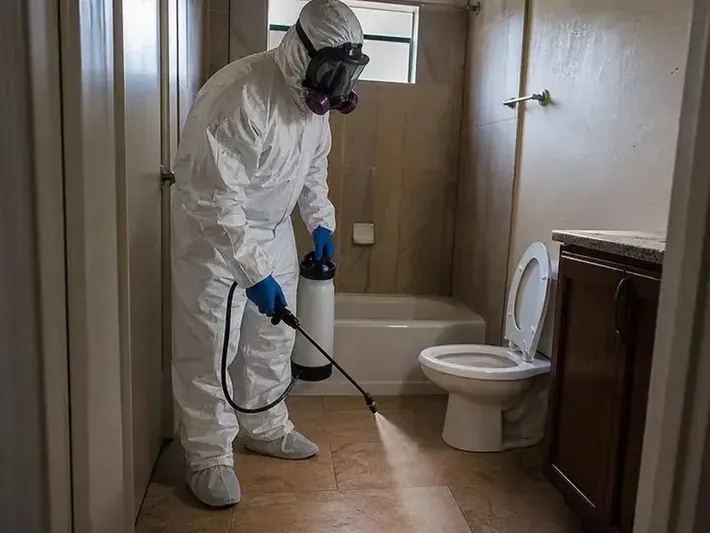
- Personal protective gear is used throughout.
What a household should do first
A calm first few steps limit the damage.
If the problem looks like it is outside the property, use the JCSUD emergency option. If it looks like it is inside, a plumber is the next call.
- Stop using water. No flushing, dishwashing or laundry until the source is known.
- Keep children and pets out of the affected area.
- Do not mop or vacuum sewage with household equipment.
- Open windows only if it is safe, and avoid spreading the water to clean rooms.
- Take photos before anything is moved.

The cleanup, step by step
Cleanup begins with extraction. The crew pulls contaminated water out of the room with pumps or wet vacuums and bags the debris.
Next comes removal of porous materials and disinfecting. Hard surfaces are scrubbed, treated and rinsed, and the room is then dried.
Drying after disinfecting
Dehumidifiers and air movers remove moisture, and meters confirm the dry standard. The structure has to be dry as well as clean.
Verifying the result
Surfaces are checked and the air is monitored. The goal is a room that is clean, dry and ready for repair.
Where standing water has spread to other rooms, water extraction removes it before drying begins.
Newer homes, older streets and repairs
The city has many newer subdivisions beside older in-town streets. Silo Mills is a master planned community of about 840 acres, and Heritage Hills is another neighborhood, so home ages and construction vary block to block.
That variety matters for repairs. Joshua City Hall lists building, plumbing, mechanical and electrical permit applications on its development services page, and the city requires plumbing contractors and building contractors to register.
After cleanup, a rebuild of drywall, flooring or cabinets may involve those permit steps. Other water damage services for homes across Joshua cover the rest of the rebuild.
About 62.5 percent of housing units are owner occupied, so many backups also involve rented homes, where the landlord needs to be told early.
A note on rentals and landlords
When a rented home backs up, the tenant's first job is to tell the landlord or property manager in writing and keep photos. Cleanup can start quickly, but repairs to the pipe and the rebuild usually need the owner's approval.
Tenants should also keep belongings out of the affected rooms, since sewage-soaked furniture and clothing may need to be discarded.
Reducing the chance of a repeat
A backup that is cleared once can come back if the cause remains.
The same steps apply across the wider area, as described under sewage backup cleanup.
- Avoid flushing wipes, grease or paper towels.
- Do not pour cooking grease down drains.
- Have a plumber inspect a recurring slow drain.
- Report repeated trouble to the utility so the district can check its side.
- Keep a record of dates and fixtures affected.
Questions
Who handles sewer service in Joshua?
The city states that water and sewer service is provided by the Johnson County Special Utilities District, whose wastewater department serves primarily the city.
Why is a sewage backup treated differently from a pipe leak?
Sewage is Category 3 water. It carries contaminants, so porous materials are removed and surfaces are disinfected, not dried and kept.
Can cleanup start before the pipe is fixed?
Often yes, once the source is stopped or the fixture is out of use. The cleanup and the repair can run in parallel.
What should be done if several drains back up at once?
Stop using water, keep people away from the affected area, and report it to the utility or a plumber. Several fixtures failing together can mean a shared pipe is blocked.