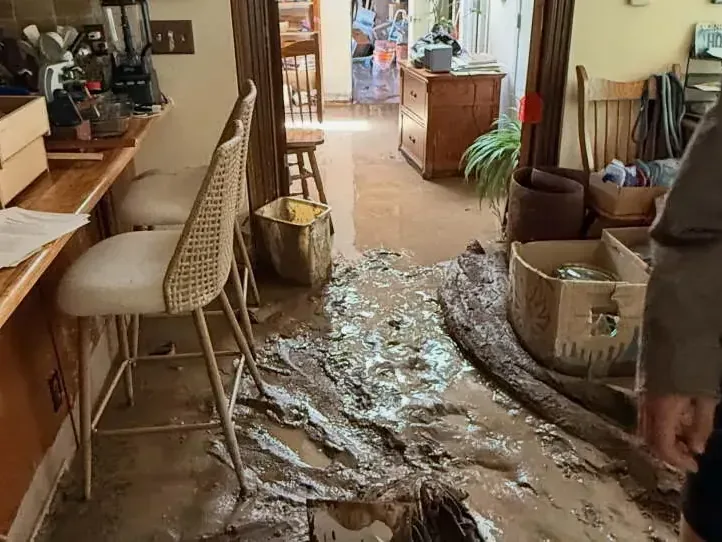
Heavy rain does not have to flood a whole street to put water in a house. Runoff can slip under a door or through a garage threshold and spread across a concrete slab floor in a thin, wide layer.
Key takeaways
- On a slab floor, water spreads wide instead of pooling deep, so a thin layer can wet baseboards and cabinet bases across several rooms.
- Runoff from a storm or creek crosses yards and streets first, so it is treated as contaminated water.
- Wall bottoms, baseboards and the edges of flooring wick water upward from the wet floor.
- Extraction comes first, followed by removal of porous materials and structural drying.
- A drying time estimate depends on materials, humidity and how quickly the water is removed.
Deer Creek and a growing city
Pioneers farmed along Deer Creek around 1848, and the town later moved to today's downtown when the Gulf, Colorado and Santa Fe Railway laid tracks. There is also a USGS gauge on Deer Creek at IH-35W near Crowley.
The city has grown quickly. Crowley had 12,838 residents in 2010 and 18,070 at the 2020 census, up 40.8 percent, and many streets, lots and driveways have been built since.
More paved surfaces and rooftops mean more runoff reaching ditches and creeks during heavy rain. That does not mean every storm floods homes, but it explains why drainage matters.
How water behaves on a concrete slab
A slab-on-grade house has no space under the floor for water to drain into. Water that enters stays on the surface and spreads outward in every direction.
A quarter inch of water over a living room, hallway and kitchen is a lot of wet area, and it reaches the bottom of every wall in its path.
This is why a small entry of water can still be a large cleanup.
In a single-story slab home, there is also no second floor to protect, so the whole living area sits at the same low level as the door where the water came in.
- Thin water covers more floor than deep water in a small area.
- Baseboards, door casings and cabinet bases sit in the wet zone.
- Carpet and pad act like a sponge that holds water against the slab.
- Water can move into closets and under interior walls.
Where the water gets in
Water finds the lowest and weakest spots. Understanding them helps a homeowner check quickly after a storm.
Clearing gutters, extending downspouts and checking grading around the house help, but they do not remove the need for a response when water arrives.
- Under exterior doors, especially at garage thresholds.
- Through gaps around windows and wall penetrations.
- Along the joint where wall meets slab.
- Through a garage floor that slopes toward the house.
- From a roof or gutter that dumps water at the foundation edge.
Why runoff counts as contaminated
Runoff crosses lawns, streets and driveways before it reaches a door. It picks up soil, fertilizer, fuel, animal waste and bacteria.
That puts the water in a contaminated category. The rules change from those for a clean pipe leak.
The storm and flash flood cleanup service follows this order so nothing contaminated stays in the structure.
- Carpet and pad that soaked up runoff are normally removed.
- Insulation and drywall low on the wall are cut out if they wicked water.
- Hard floors and wall surfaces are cleaned and disinfected.
- Belongings that cannot be washed are often discarded.

Extraction first, then drying
The extraction crew uses truck-mounted and portable units to pull water off the slab. Removing it early keeps it from wicking higher into walls.
Once the standing water is gone, structural drying takes over. Air movers push dry air across surfaces, and dehumidifiers remove the moisture that comes out.
Moisture meters set the pace
Meters show how wet drywall, baseboards and the slab surface are. Equipment is placed where readings are highest and adjusted as they fall.
The slab dries slowly
Concrete holds water and releases it slowly. Even when the surface looks dry, the slab can still hold moisture that affects flooring.
Readings are repeated until the slab and wall bottoms meet their dry standard. Only then is replacement flooring safe to install.
Watching the weather and the creek
A USGS gauge records conditions on Deer Creek at IH-35W near Crowley, and the National Weather Service Fort Worth office issues alerts for flash flooding in North Texas. Together they give an early sense of whether heavy rain is a nuisance or a threat.
Preparing on a dry day makes the first hours of a wet one calmer.
A household that knows its weak spots also knows what to lift first. Furniture legs on wet floors can stain, and electronics left on the floor are the first to be lost, so moving them early is the cheapest protection there is.
- Check forecasts before a heavy rain day.
- Know which door or garage threshold lets water in first.
- Move electronics and papers off low shelves and floors.
- Keep a flashlight and a way to shut off power handy.
Estimating drying time
Drying time depends on how much water entered, how long it sat, what materials are present and how humid the air is.
The drying time estimator offers a rough picture of how long equipment may run for a given loss.
- Larger affected areas need more equipment and more days.
- Porous materials left in place slow the process.
- High humidity makes drying slower.
- Faster water removal shortens the whole job.
What to do in the first hours
A short list keeps the first hours organized.
Mold can grow in damp materials, so delay raises the cost.
The water extraction crew can remove the water, and the drying team then handles what remains. For a loss that reaches several rooms, early action is the most useful advantage a homeowner has.
- Stay out of rooms with water near electrical outlets.
- Turn off power to the wet area if it can be done safely.
- Lift furniture off wet floors or place blocks under legs.
- Move rugs, papers and electronics to dry areas.
- Photograph the water and the damage.
- Begin extraction as soon as it is safe.
Questions
Why does a small amount of water on a slab cause so much damage?
Water spreads wide on a flat floor, so a thin layer can reach every wall in its path and wick up baseboards and cabinet bases.
Is runoff from heavy rain clean water?
No. Runoff picks up soil, fuel and bacteria on the way, so it is treated as contaminated and porous materials are usually removed.
How do pros know when a slab home is dry?
Moisture meters measure walls, baseboards and the slab surface, and equipment stays until the readings reach the dry standard.
What can homeowners do before a storm?
Clear gutters, extend downspouts, check grading near doors and keep valuables off the floor in rooms near exterior doors.